


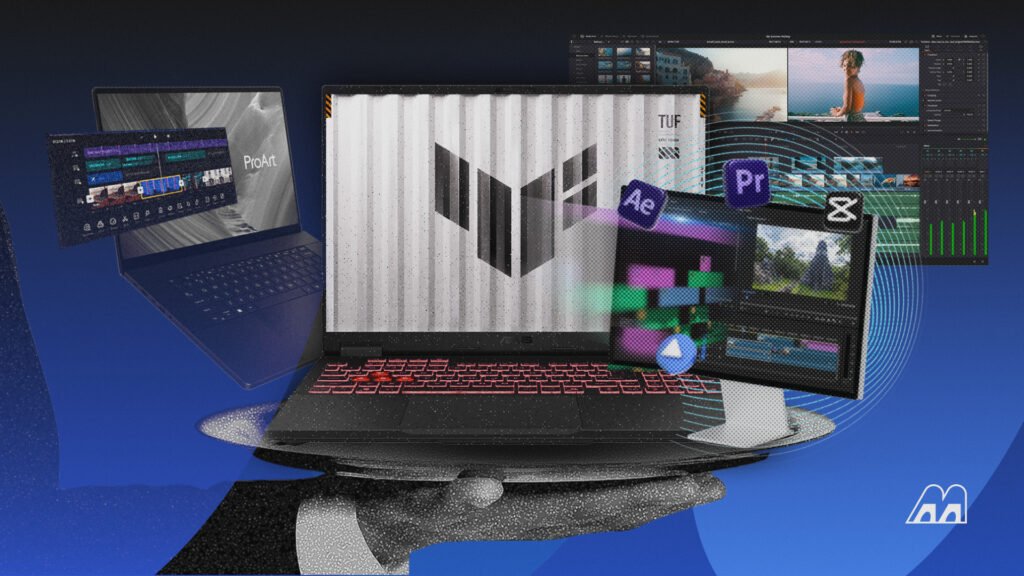
Video has become standard marketing content, with
<p><img src=” https: alt=”Apple MacBook Pro 16 M5 Pro”>
The 16-inchMacBook Pro M5 Procombines an18-core CPU with up to a 20-core GPU, 307GB/s memory bandwidth, and dedicated media engines for H.264, HEVC, ProRes, ProRes RAW, and AV1 decoding. These media capabilities are particularly useful for editors working with high-resolution footage and Apple’s supported codecs.
The16.2-inch Liquid Retina XDR displayis equally important. It offers 1,000 nits of sustained full-screen XDR brightness, up to 1,600 nits peak HDR brightness, wide P3 color, and ProMotion up to 120Hz. You also get 24GB of unified memory as a starting point on the M5 Pro configuration, with higher-memory options available. For accurate
M5 Pro power with a 15-core CPU, 16-core GPU, 24GB unified memory, 1TB SSD, and a 14.2-inch Liquid Retina XDR display.
Creators need workstation-level components in a laptop they can still carry around. ASUS offers theProArt P16withAMD’s Ryzen AI 9 HX 370 and graphics options ranging from the RTX 4060 to the RTX 5090 Laptop GPU. The top configuration pairs the processor with NVIDIA’s flagship mobile GPU and up to 128GB of unified memory.
The display makes the P16 particularly interesting for editors. Its16-inch OLED panel runs at 4K resolution, supports 120Hz, reaches up to 1,600 nits HDR peak brightness, and covers 100% of DCI-P3. PANTONE video editing laptop for creators who frequently move between home, office, and location shoots. It comes with a14.2-inch Liquid Retina XDR display and up to 48GB of unified memoryin a much smaller package. The base M5 has a 15-core CPU and 16-core GPU, along with hardware acceleration for H.264, HEVC, ProRes, ProRes RAW, and AV1 decoding. The display reaches 1,600 nits peak HDR brightness and covers the wide P3 color space.
Battery lifeis another reason it works well for mobile editors. Apple rates the M5 model forup to 24 hours of video streaming, although intensive video editing tasks will be far more demanding. Three Thunderbolt 4 ports, HDMI, SDXC, MagSafe, and a headphone jack also reduce the need for dongles.
4. Acer Predator Helios Neo 16S AI
Acer’sPredator Helios Neo 16S AItakes thegaming-laptoproute and makes surprisingly good sense as an editing machine. It combinesIntel’s Core Ultra 9 290HX Plus with an RTX 5070 Ti and 32GB of DDR5 memory. The GPU has 12GB of GDDR7 memory, which gives editors considerably more room for GPU-accelerated effects and demanding timelines.
Acer also gives it a16-inch 2560 x 1600 stunning OLED display with a 240Hz refresh rate and 100% DCI-P3 coverage. The refresh rate is largely irrelevant for editing, but the OLED panel and wide color coverage are useful when you’re judging footage. It can comfortably handle serious Premiere Pro, DaVinci Resolve, and After Effects work.
5. HP OMEN 16 OLED
TheHP OMEN 16is the option we’d look at when acapable video editinglaptop needs to stay within a tighter budget. It can be equipped with Intel’s latest Core Ultra processors, up to an RTX 5070 Laptop GPU, up to 64GB of DDR5 memory, and up to 2TB of SSD storage.
The OLED display configuration is particularly attractive for editing. HP lists a16-inch 2560 x 1600 panel with up to 165Hz refresh, 500 nits SDR brightness, up to 1,100 nits HDR brightness, and 100% DCI-P3 coverage.
The catch is that configurations vary considerably largely because it falls within the range of best budget laptops. A model with 16GB RAM and an RTX 5060 isn’t in the same performance class as a 64GB RTX 5070 configuration. We’d prioritize at least 32GB RAM and the stronger GPU if you regularly edit 4K footage.
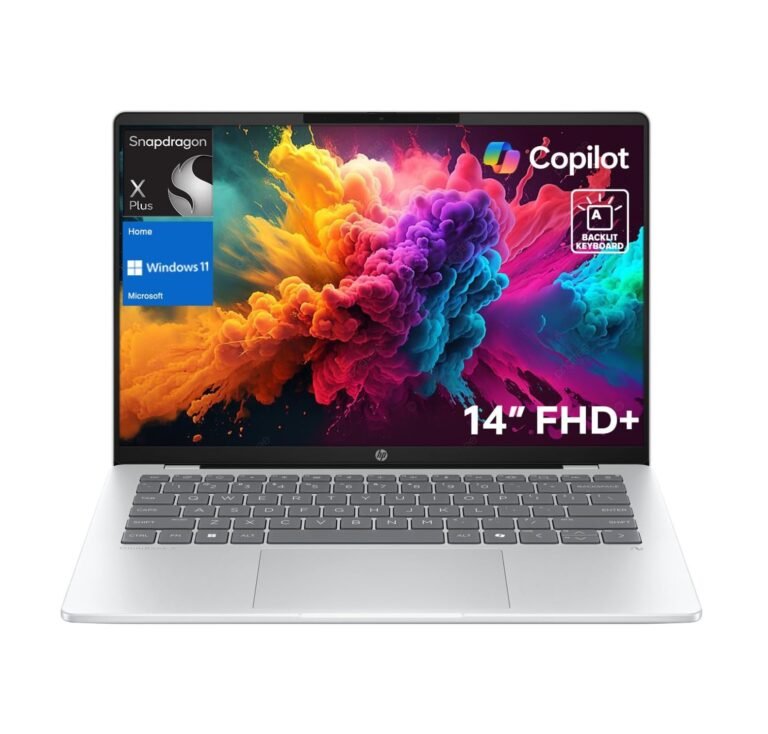
14-inch OLED display, AMD Ryzen processor, 16GB RAM, 512GB SSD, integrated Radeon graphics, Wi-Fi 6E connectivity
Samsung’sGalaxy Book6 Ultrais an unusual proposition. It puts dedicated RTX graphics into a relatively slim 16-inch Windows laptopwhile keeping the machine closely integrated with Samsung’s broader device ecosystem. Current configurations use Intel Core Ultra Series 3 processors with RTX 5060 or RTX 5070 graphics and 32GB or 64GB of LPDDR5X memory.
The 16-inch Dynamic AMOLED 2X display is a major attraction. Samsung lists a WQXGA+ resolution, 120Hz adaptive refresh, up to 1,000 nits HDR brightness, and touch support. You get generous storage of up to 2TB, with an expansion slot also available. Theoled screenprovides the kind of contrast andscreen qualitythat creative professionals often look for when evaluating footage.
The real advantage is mobility. You get adedicated GPUwithout carrying a thick workstation. This makes it useful for creators who want anultraportable laptopwithout giving up discrete graphics.
8. Lenovo ThinkPad P1 Gen 8
TheThinkPad P1 Gen 8makes sense foreditors who need a professional workstation that can also handle demanding business workflows. Lenovo offers Intel Core Ultra H-series processors, up to 64GB of LPDDR5X memory, and NVIDIA RTX PRO graphics, including the RTX PRO 2000 Blackwell generation.
Storage is one of its biggest strengths. The P1 Gen 8 supports two M.2 drives with up to 4TB per drive, allowing configurations of up to 8TB. It can also drive multiple external displays, including up to three 4K displays at 60Hz through its Thunderbolt ports and HDMI connections.
9. MSI Creator A16 AI+
MSI’sCreator A16 AI+sits betweena conventional gaming laptop and a traditional creator workstation. The configuration range includes AMD’s Ryzen AI 9 HX 370 with up to 50 NPU TOPS, alongside NVIDIA GPUs ranging up to the RTX 4070. MSI also offers several display choices, including 16-inch QHD+ 240Hz panels, a 3.8K 120Hz Mini-LED option, and an OLED configuration.
We like the A16 AI+ for creators who want Windows flexibility without buying a laptop designed exclusively around gaming. Its main weakness is the variation between configurations, so check the exact screen and GPU before ordering.
10. ASUS ROG Zephyrus G16
From our perspective, theZephyrus G16is the obvious choice forsomeone who edits during the day and games after work. ASUS offers the 2026 model with Intel Core Ultra 9 386H processors and graphics options reaching the RTX 5090 Laptop GPU. The range also includes RTX 5060, 5070, 5070 Ti, and 5080 configurations.
Its 16-inch 2.5K OLED display supports 240Hz, 100% DCI-P3, G-Sync, and Pantone validation. Those gaming features don’t hurt an editing workflow, while the wide color gamut and OLED contrast make the screen useful for creative work.
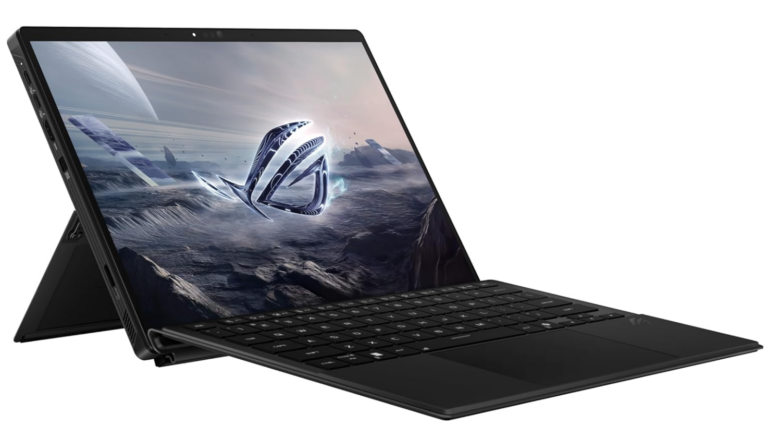
ROG Nebula Touchscreen 13.4″ Convertible 2-in-1 Gaming Notebook AMD
Start With Your Editing video editing software and backup storage. Premiere Pro, DaVinci Resolve Studio, Final Cut Pro, plug-ins, fonts, stock footage, cloud storage, and backup drives can add considerably to the total cost of your setup.Final Verdict
The best laptop for video editingdepends on your software, budget, and how much you value portability against raw power. The Apple MacBook Pro 16 M5 Pro remains our overall pick for its balance of performance, display accuracy, and battery life, while the ASUS ProArt P16 is the strongest Windows alternative for editors who need NVIDIA GPU acceleration.
If portability matters most, theMacBook Pro 14 M5 covers most 4K workflows in a lighter chassis. Editors on a tighter budget should look at theAcer Predator Helios Neo 16S AI or HP OMEN 16 OLED, both of which deliver real OLED accuracy without the premium price tag. For GPU-heavy VFX work, theRazer Blade 16 and ASUS ROG Zephyrus G16offer the most graphics headroom on this list, provided your budget can stretch to match.
What type of laptop is best for video editing?
TheApple MacBook Pro 16 M5 Prois the best type of laptop for video editing, combining powerful performance, dedicated media engines, ample memory, fast storage, and an excellent color-accurate display.
What laptop do most YouTubers use?
Many YouTubers use14-inch or 16-inch MacBook Pro models, while Windows creators often choose ASUS ROG, Lenovo Legion, or other laptops with dedicated NVIDIA graphics.
What should I look for when buying a laptop for video editing?
Prioritize apowerful CPU, sufficient RAM, a capable GPU, fast SSD storage, and a color-accurate display. Port selection, battery life, and cooling also matter for longer editing sessions.
Do I need a dedicated GPU for video editing?
Not always. Integrated graphics can handle basic 1080p editing, but a dedicated GPU becomes increasingly useful for 4K footage, complex effects, color grading, rendering, and GPU-accelerated workflows.
What’s the best laptop for Adobe Premiere Pro?
TheApple MacBook Pro with M5 Pro is a strong overall choice for Premiere Pro, while the ASUS ProArt P16 offers powerful NVIDIA graphics for Windows-based, GPU-heavy workflows.
What’s the best laptop for DaVinci Resolve?
The16-inch MacBook Pro with M5 Pro is a strong choice for mixed Resolve workflows. Windows editors should consider the ASUS ProArt P16 or Lenovo Legion Pro 7i with RTX graphics.
