




Noel Goddard, CEO of Qunnect, Inc., which has deployed more quantum networks around the world than any other company in the United States.
The next great battle for national security may not be fought over who has the fastest computer, but over who can protect the information moving between them. The <a s going to do so in the next 10 years. A lot of times, people joke about the fact that quantum computing is always 10 years ahead. But realistically speaking, quantum is a science developed in the 1920s. So, the idea that we're only 100 years downstream, and we've learned how to take things that were very difficult to realize experimentally, and now we can actually engineer with them, is the springboard for the next technology revolution.”
One of quantum technology’s most urgent applications is cybersecurity. Today’s digital economy depends on encryption to protect banking, online purchases, private communications and sensitive information. More powerful computing systems, however, could eventually undermine some of the mathematical problems on which conventional encryption relies.
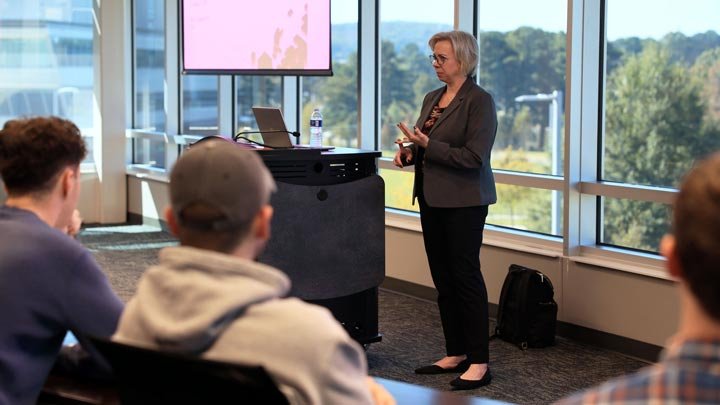
Goddard also met with UAH computer science and engineering.
“For banking, when you do a Zoom call, when you make an Amazon transaction, all things like these are protected, and when cybersecurity is working, you take it for granted. And when it’s not, everybody’s at risk,” Goddard pointed out. “The encryption we use today was invented in the 70s, and it has withstood the test of time. But it has been a primary target of advanced computing power for those who want to take down our systems. So, this is why quantum networking also has a big role in security.”
Harnessing quantum entanglement
Quantum networking offers a different approach to <a s technology is a phenomenon known as “entanglement,” in which separate quantum particles share correlations that can be used to establish and verify quantum information.
“You can create light particles from a single event where the pair is created at the same time,” Goddard explained. “Because they came from one event, they’re correlated strongly in terms of their quantum states. The correlation itself is the information which we preserve when we try to send it over the network. So, if I keep one and I send one to you, then we should know this, because it came from the same event.”
Those correlations can provide a means of checking whether information has been disturbed during transmission, supporting security protocols that differ fundamentally from conventional mathematical encryption.
“It turns out that all of our encryption systems are mathematically based, and if you would like to be able to create something which is quantum-proof, it needs to harness the rules of quantum to fight quantum,” the speaker said. “So, we develop systems where the encryption of the information itself is physically encrypted onto the particles <a s work.
“If you can deliver the actual entanglement to its location, then you can do things today without a quantum computer. So, security protocols are natural, because you have a pair of bits which were physically defined at the time of creation which you can now use in order to have absolute information that the sender and receiver can check against each other.”
From laboratory to commercial networks
The company Goddard leads, Qunnect, is helping to advance quantum technologies specifically for networking. The firm introduced the world’s first commercial room temperature quantum memory, which was named one of
<p>The company is also working with the
