


This targeted approach could offer a way to prevent the recurrence of aggressive brain tumors.
Anne Trafton|MIT News
Publication Date:
October 26, 2026
Press Contact:
Sarah
McDonnell
Email:s_mcd@mit.edu
Phone:617-253-8923
Fax:617-258-8762
MIT News Office
Close

Caption:
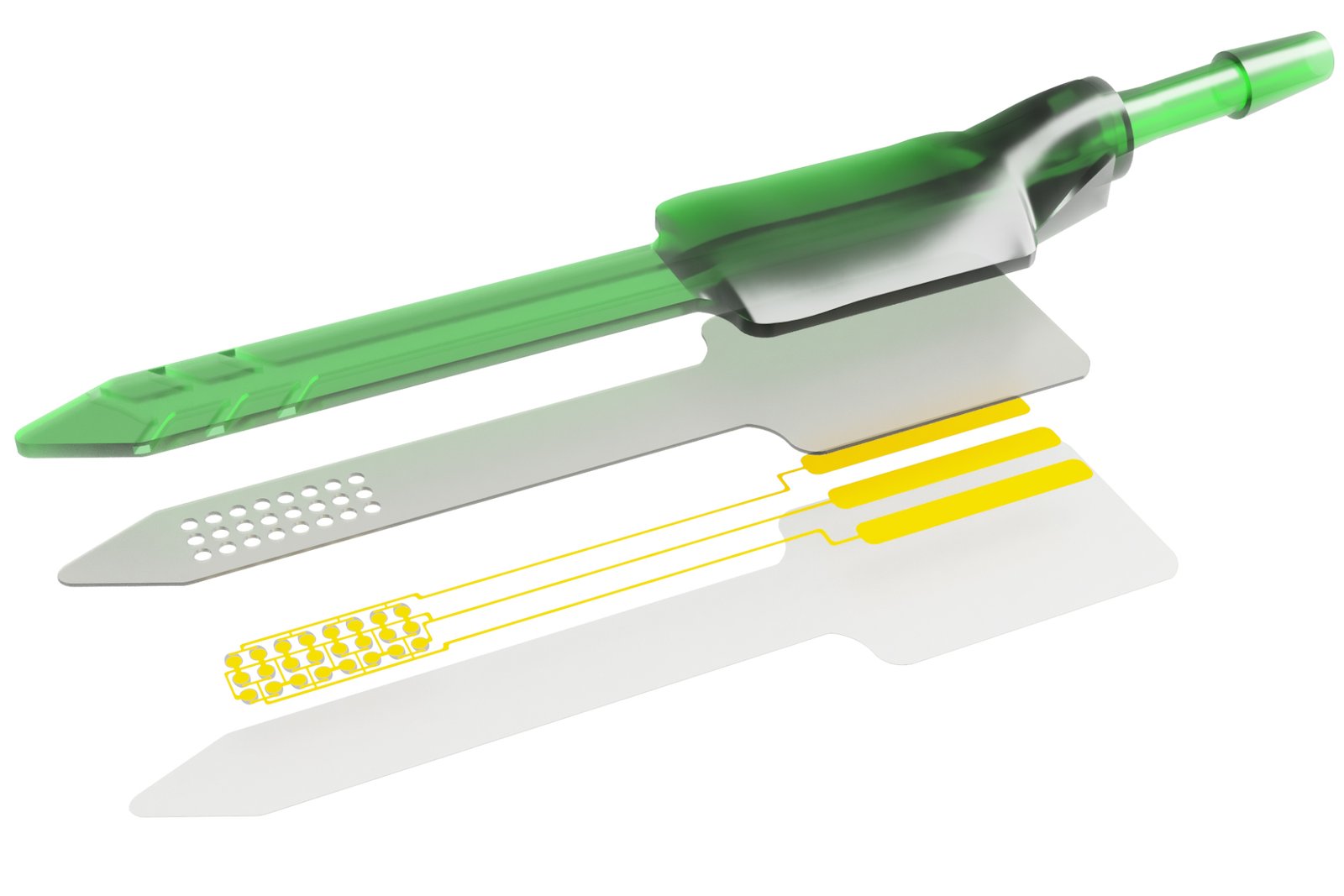
An illustration shows how LUCID combines a 3D-printed fluid-delivery channel with a layered miniature ultrasound array. This integrated structure brings ultrasound generation and local infusion together in a single device. Components are separated for illustration.
Credits:
Credit: Courtesy of the researchers
Caption:
The LUCID prototype, which combines a miniature ultrasound device with a fluid-delivery tube, an osmotic pump, and custom electronics. A coin provides a sense of scale. The system is designed to deliver substances directly into brain tissue and uses ultrasound to help them spread.
Credits:
Credit: Courtesy of the researchers
Patients with glioblastoma, an aggressive type of brain tumor, usually undergo surgery to remove the tumor. However, it’s difficult for surgeons to remove all of the cancer cells, and the tumor often recurs.
MIT researchers have now designed an implantable drug-delivery device that they hope could help prevent recurrence of glioblastoma. Their device contains a reservoir that can release drugs over an extended period, along with ultrasound transducers that use sound waves to help drugs spread farther through the brain and bypass the blood-brain barrier.
Such a device could be implanted in the brain during surgery, then gradually release drugs that would help kill the remaining tumor cells. After implantation, a wireless controller can be used to program the exact ultrasound dosages to be delivered, enhancing the reach of the delivered therapy.
“We have 24 transducers in one ultrasound array, which can help a given drug bypass the blood-brain barrier and enhance the drug infusion. The device also gives doctors options in terms of the size, the length, and the number of infusions,” says Canan Dagdeviren, an associate professor of media arts and sciences at MIT and the senior author of the study.
