


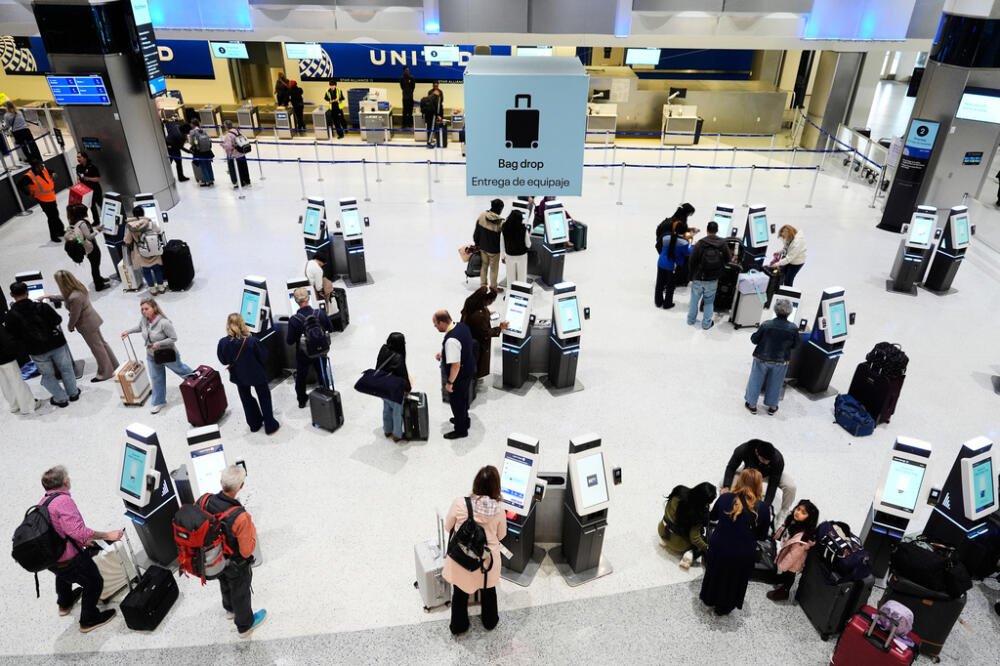
Passengers check in at George Bush International Airport on Saturday, Nov. 14, 2026, in Houston, after the Federal ALandis/AP)
Tech outages have recently flooded the system from autages are only to be expected. What the era of “software Beirut” means for us all
Guests
Galina Antova, CEO and Co-founder of Kai, a San Francisco–based cybersecurity AI <a re following what the FAA is now calling extraordinary circumstances. It has ordered a ground stop at every airport across the country, ordering all departing traffic to stay on the ground until further notice.It says the order is necessary due to what it calls reasons of safety.
CHAKRABARTI: That was, of course, two weeks ago Friday. It was the first time the U.S. Federal Airspace since the terrorist attacks of September 11, 2001. 3,500 planes were grounded and more than 12,000 flights canceled
Then, just two days later, on Monday, November 16th, the world’s largest banks experienced major tech issues, places like Bank of America, JPMorgan Chase, Wells Fargo. And this past Sunday, on November 22nd, over 1,000 Delta flights were delayed after an automated system that calculates an aircraft’s weight malfunctioned.
So tech and software outages seemingly everywhere all at once. U.S. Secretary of State Marco Rubio says there is no connection between them.
RUBIO: We have zero evidence whatsoever. We have no indication, no evidence, and no reason to believe at all that any of these incidents are related to each other.
CHAKRABARTI: So they might not be specifically related to each other, but I would say they spring from the same underlying truth.
We rely on software for every major system that holds our societies together, and that software is more vulnerable than ever, which means so are we. So do you ever wonder if the vulnerabilities are beginning to maybe outweigh some of the advantages of the relentless tech and AI revolution? Charlie Warzel joins us to talk about this now.
He’s a staff writer at The Atlantic and also author of its newsletter and podcast, Galaxy Brain, which focuses on technology and media, and he joins us from beautiful Bellingham, Washington. Charlie, welcome to On Point.
CHARLIE WARZEL: Thanks for having me.
CHAKRABARTI: Okay. So first of all, I actually want to almost do a little bit of public service journalism for the first many minutes, Charlie, and kind of go through what we know about each of these outages and what the companies or administration has said caused them.
So first, regarding that FAA ground stop, I’m just wondering what your first reaction was. Were people asking you if the apocalypse had come? What was going on that day?
WARZEL: Yeah. Yes. The answer is a lot of people were asking me. I think if you write about technology right now, and especially <a re one of those people that folks call to say, are the end times here, right?
And so you’re doing a lot of, I used to do a lot of tech support for people. Now I end up doing a lot of emotional support … I don’t know, psychology.
CHAKRABARTI: Emotional support. (LAUGHS)
WARZEL: Emotional support. Exactly. Just to be very clear I don’t think that this is the end times here.
The FAA ground stop was basically a router and upgrade issue. There was work by this contractor called L3Harris upgrading this aging copper wire in fiber optic cables. And this router replacement apparently basically went haywire, flooding other routers with these connection attempts, overloading all these switches and basically causing radar inconsistencies.
The FAA ground stop was basically a router and upgrade issue.
Charlie Warzel
So this is upgrade work, right? This is the work of trying to modernize systems that are older. One of the issues, too, in modernizing especially our air traffic control systems is they used to be very siloed, right? So if you upgraded one terminal one system, and there was a problem, it might have been contained to that one system.
But the more that you link these systems together in an attempt to make them more efficient, there can be these issues where the problems cascade throughout the system and make it much worse than it would’ve been. So that is, I think, a really good example to ground this whole conversation, which is that something that seemed really concerning and scary in this larger picture of both <a t done it in a quarter century, because look, if airplanes are having a hard time connecting with air traffic control, you don't want airplanes in the sky.
But let me … can I just dig a little bit deeper here into the ground stop, Charlie, for a second? Because you’re right. The FAA’s own press releases are saying, yes, L3Harris, which is that company that you said that was working in tiny El Dorado, Arkansas took that router offline once they figured out that it was basically pinging the network like 1,000 times every four seconds and causing this data overload.
But their press release, the FAA’s press release also says the initial investigation indicates two potential locations Arkansas being one of them, and the other is a radar site in Amarillo, Texas but then the rest of the press release doesn’t actually say anything more about Amarillo.
I’m wondering if you have heard anything?
WARZEL: I have not. Okay. One of I think the issues here is that and this is part of my, we can go through it if you want, my grand theory of how all this is happening. But one of the issues is the communication of this administration, right?
I think as this whole outage was unfolding, you had people from the transportation department who were casting a lot of blame about, with the systems that they inherited and not having enough money to upgrade the systems. They were doing the Trumpian thing of getting up at the podium and having these long discursive press conferences that were issued before they had all the facts, right?
And then you had people in the administration coming on TV and saying, I talked to somebody in tech world and they said that this could be AI, but we’re not sure. That’s very confusing communication from the people who are in charge and it leaves people with more questions than answers.
So I think the unreliable narrator part of this administration, or at least for the people who don’t trust this administration, which is a reasonable part of the country, that plays a huge issue here. And so when you have things like the press release that you’re talking about, some people might be willing to theorize about that in ways that contend towards the conspiratorial or just have more questions than answers.
CHAKRABARTI: Yeah. So bad communication being perhaps anotherut because it’s actually quite significant when it comes to social cohesion, but we’ll talk about that later. Let’s go backwards to Microsoft because, look, that one cascaded across 70 countries given how global Microsoft’s services are
Any insight into what 430 million users had to go through when they couldn’t rid their Outlook inboxes of spam?
WARZEL: The reports that I have read and heard about are that basically this was an old bug that malfunctioned. There was issues with server capacity.
And it was a number of things happening at once, is what I’ve heard. So when you add it together, it led to this kind of cascading again outage that’s very difficult to mitigate. It’s very difficult to repair. But this is something that wasn’t even new.
It was what they’re calling a latent bug and a defect from July. And so this caused servers to become unresponsive and essentially overwhelmed. And attempts to fix part of these things can sometimes cause problems in other parts. I think it’s very important for people to realize, and I’m not an expert here, but you can almost think of it sometimes as trying to fix things in your house and not knowing exactly what to do.
And sometimes you can cause something else to be damaged or if you’re upgrading the electrical in your house or something like that and you tweak a wire or a wire kind of crosses and gets pinched by another one, you might not realize what you did, but there are these issues that go down the chain.
So that’s a big piece of this as well.
CHAKRABARTI: Okay. So we’re starting to see a pattern though, and again, I agree with you. I don’t think there’s any conspiracy. I don’t think that this was a North Korean stealth attack. Again, I’ll think that until there’s proof that it was, but we don’t have that proof yet.
But the pattern is emerging in terms of like systemic weaknesses in our technological systems. Because moving to the banks, Chase said that it experienced a temporary issue related to a software. There’s a … here’s the bug. The word again, bug, in on-premises hardware systems. And they didn’t, they said it was not a systemic issue, but the bug caused them to take longer than usual to provide service to customers.
Again, I’m not … They’re not saying exactly what the bug is. I don’t know if you know if it’s also an old one or a new one. You have any insight there?
WARZEL: I actually don’t know if it’s an old one or a new one. This one though for me is actually, it falls into this category of would we have called this an outage if it wasn’t happening amidst all the rest of these outages?
I’m not saying that not being able to access your bank is a good thing, right? Or the, I think one of the problems here too was that these, when you were going into your account, you couldn’t see your balance, the number that was your balance, which is a freaky thing for lots of people.
I absolutely understand and sympathize with that. But I do think we are getting to this point where you have these things, we’re lumping them all together as outages, and I am, I’m not sure if this were happening in a vacuum, in isolation, if we would’ve even really noticed it in the same way, right?
This idea that you could go to your phone, and you could see that your bank software was glitching for a little and you’d say I guess I’ll just … I’ll check it in an hour or two. And then you come back and the balance is there, everything’s working fine. You might not feel very much there, but because it’s happening in tandem with all the rest of these things, people have, their hackles are up.
Part II
CHAKRABARTI: Charlie, so just to, I’m just going to tell you why I disagreed with your thought that maybe we wouldn’t be calling these outages at other times. And the reason why I say that is because we’re talking about major societal systems. Anything that disrupts even for a moment, I would say, the financial system should be considered a kind of outage because of the centrality of the financial system in society.
Anything that disrupts the safety of the skies. This isn’t when the student software Canvas, it had an outage a couple of months ago, and hundreds of thousands of students weren’t able to access their homework. That might have been bad for those kids, but it’s not the same level of wow, it’s shaking our fundamental sense of security that basic stuff that has to work does.
Do you see what I’m saying?
WARZEL: I do, but what I would say in response to that is that it’s actually, it’s similar to the Canva software because they’re both software. These things are essentially very similar to each other. And there’s a couple people online who pulled some of this data about documented incidences with outages, outage clusters over the years, and they mapped the last 20 years from 2006 to 2026.
And they were looking at, are we experiencing a larger cluster of outages right now? And what they found is that we are experiencing a good bit of outages for sure at this moment, but if you go back historically, it’s not even the most that we’ve experienced this. If you go back to August 2013, the month of August 2013 had a higher incidence of outage clusters of more of these than we experienced in the last month. And so I just think that a sense of proportionality here makes sense. I’m not saying this isn’t actually a very real situation.
I think that it is, and I do think that when infrastructure breaks like this it can freak people out. But I would just say this reminds me quite a bit of this period in in early 2024 when there were a series of air incidents, airline incidents. And people, myself included, were a little bit freaked out about flying because we were seeing this series of concerning reports.
But the media is an ecosystem too that has its own vulnerabilities. And I say this as someone who’s in the press. I think we start to notice this. We start to report these things. We start to see these trends and it raises an awareness, and there’s nothing wrong with a raised awareness, but it does make you see things in a different light.
CHAKRABARTI: Absolutely, we should scrutinize our own selection bias in the media 100%. But about that analysis that you just quoted from, Charlie, when you said that it was 2013, 2014, there were more outages than we’re experiencing now, were they at the same scale, or were they more localized?
WARZEL: I honestly, I do not know. But I think this all speaks to what our definition of an outage is, right? And I don’t mean that to be, like, super pedantic and annoying. What I mean is our software has always broken, and it’s always been really finicky, and people are always pushing updates that cause outages and repairing things. And I think the history of cybersecurity is as a race between people who are trying to repair things and trying to exploit things, and sometimes the race gets out of balance, and that’s concerning.
But I do think when we notice these things so much, the idea that something goes down for an hour or two, that there was an NSA outage in a couple classified systems recently, and that outage was actually very short. And that’s not to say that’s not important.
This is the NSA. This is very important infrastructure. But what seems really clear to me as an outsider to that is that all of this information is going on at once. We’re having this heightened awareness, and some people noticed that the system that they access wasn’t working. They got really spooked, and they alerted people to it in a way that maybe they wouldn’t have alerted people to that 8, 10 weeks ago or something like that, or five years ago.
And so I just don’t know as a journalist if these systems are actually going out frequently all the time and we just didn’t notice.
I just don’t know as a journalist if these systems are actually going out frequently all the time and we just didn’t notice.
Charlie Warzel
CHAKRABARTI: Okay. So this is really important. So there’s two main issues here. There’s the technical side, which actually I have the perfect guest to help us understand that, which I’ll introduce her in a moment, but then there’s also the sort of social side, right?
And I’m going to use this phrase over and again, the social cohesion side of this. And I think that when we talk about the FAA or banks or things like that, and even temporary outages, I think that people are right to actually be quite concerned about that. We’ll come back to that later.
But let me bring Galina Antova into the conversation now. She’s CEO and co-founder of Kai. It’s a San Francisco-based cybersecurity AI platform that focuses on managing cyber exposures and threats and makes fixes across critical infrastructure. She’s also founded other companies, Clarity, a critical infrastructure cybersecurity company, and she’s got decades of experience in this field.
So Galina, welcome to On Point.
GALINA ANTOVA: Thank you for having me.
CHAKRABARTI: Okay. So first of all, what is your view about the cluster of, quote-unquote, “outages” that we had? Are there any sort of fundamental commonalities, or was this kind of one of those black swan events that it’s just purely by coincidence that they all came so close to each other?
ANTOVA: Yeah, I think first of all, it is to be expected. I think we’re going through very interesting times, and we’ll be going through those interesting times probably for the next couple of years. The reality is that the world relies on software. Literally everything runs on software, whether that’s our computers, all of the infrastructure that we depend on, and there’s quite a lot of technical debt into those systems.
And what I mean by that is the speed of innovation was different, and also the speed of attackers were different. And so living with that technical debt was okay because perhaps many of the vulnerabilities that exist and have existed for a very long time across software were not easy to find, right?
And so the reason this feels out of balance, and it is out of balance today, is that we are now living through a time where because of the advances in the technological advances in AI, those agentic AI systems are getting much, much better at discovering vulnerabilities that it was very hard for humans to discover. Because, again, of the computational power that those models have.
And so they’re exposing the technical debt that we have accumulated, honestly, for decades, right? And so certain parts are better than others et cetera. For example, in critical infrastructure, where I spent 15 years of my life, so this is literally all the electric utilities, manufacturing, oil and gas companies, it is even more challenging there because it is not even so simple to update the software, right?
Some of those systems have been in the field for 20, 30, 40 years, right? And so that is a lot more concerning, and it will take longer to fix.
CHAKRABARTI: Okay. So Galina, you said a lot there. Let’s parse it a little bit more. So when you say technical debt, basically what you’re saying is that if I heard you correctly, that for many decades because without, pre-AI, if bad guys were going to try and do something to a system, it was humans who had to find those vulnerabilities, and it took a long time, and so maybe we didn’t have to patch against them or fix them as rapidly as we do now. Is that what you mean by technical debt?
ANTOVA: Yeah, because we didn’t know.
We didn’t know that some of that exists. And the way … so just to put it into context, right? So software is written by humans. Humans are not perfect; therefore, the software is not perfect, right? And so that is the definition of software. It will have bugs and <a re experiencing in the last few months, really since the Mythos models came out, has been that AI and the attackers in the hands of the attackers became an accelerator to expose all of those weaknesses, and attackers need to be right once.
Defense needs to be right all the time.
CHAKRABARTI: Okay, so Mythos AI being Anthropic’s model, right?
ANTOVA: And of course, any other model that has advanced capabilities.
CHAKRABARTI: So it’s not just the attackers using agentic AI. I think I’m also hearing you say that cybersecurity folks on your side of things are also using agentic AI in order to find, faster, the vulnerabilities and fix them or patch them.
So are we seeing just a lot more updates and patching and upgrades trying to come out at much higher speed than they used to? And is that also potentially causing some of the system disruptions we’re seeing?
ANTOVA: So it’s a little bit more nuanced than that, and I’ll explain the technical situation.
But I think attackers naturally have an advantage of how fast they can move, right? They operate in small groups. They leverage technology. If you think about any meaningful system whether that’s a large organization or whether that’s the government, it is incredible amount of complexity of how all of those software components work together.
And to give you a perspective on the defender side, any large organization would have, call it 80, 100, 120 security tools that are pieced together to find those, you know, vulnerabilities and fix them. And so right now, mostly defense is moving at human speed. Of course, the reason so many of us are in cybersecurity is because we’re helping fix that, but it will take a little bit to get to a more sustainable fix, so to speak, just because of the complexity that we’re dealing with on the defender side. And again, also honestly, a little bit of inertia. At the end of the day, yes, we’re talking a lot about the technology, but I have to say from my observations, the problem is mostly humans deciding they need to act at the same speed as the attackers on the defense side.
And, attackers are not dealing with budget meetings and communication. They’re just getting organized in very smaller units and just executing, whereas for a large, any large organization, we still have that kind of oversight of “Oh my God. How are we going to patch all of this together?”
It is changing. It is changing very fast, but that is the interesting times that we live in right now.
CHAKRABARTI: Okay. Hang on for a second. I really wanna come back to that, but there’s two quick questions I wanna ask and then bring Charlie back in here. Because Charlie had said earlier that and this is a technical question but an important one, that he’s not even sure that some of these events that took place over the past couple weeks should actually be called outages from a technical perspective.
And Galina, just give us your expertise on that.
ANTOVA: Yeah, I would say I think at the end of the day, it probably doesn’t matter to the larger public whether something was caused by a cyberattack or just any kind of operational issue. The impact is exactly the same. I think the point here that is important is that given the state of technology and just the fact that attackers are moving faster, it could be a cyberattack, like just speaking of the technological facts, right?
And I think, but I think we shouldn’t exactly start with —
CHAKRABARTI: Wait. Sorry, Galina. Let me just … when you said it could be a hacker attack, are you saying that there, you still think there’s a possibility that some of these events were caused by bad actors?
ANTOVA: No, not for the ones that we just discussed. I think it’s based on all the evidence we know exactly what they were, and I think Charlie articulated that very well. I’m just saying given the technical details of where the world is, right, and again, all the technical debt, et cetera, like potentially, hypothetically, and I think this is why, by the way, probably a lot of people are jumping to that conclusion, right?
Because that is one of the likely scenarios. It wasn’t the case in those specific instances, but it could be, and that’s just the reality of the technology that we live in today.
CHAKRABARTI: Okay. Charlie, thank you for being patient while we got this technical foundation from Galina.
But it sounds to me that in a sense, we should be surprised that we’re not seeing these kinds of disruptions, in fact, more often than we currently are, Charlie.
WARZEL: I think that’s true. A couple of weeks ago, I guess maybe more than a month now there was an outage in PHP, which is a coding language that affects up to 70% of websites.
And I spoke with one of the people who helped patch that vulnerability. This person is a volunteer. They’re a programmer who does, who helps patch … and push it out to other people so people with less technical expertise are able to update their websites and make sure that things are less vulnerable.
And when I spoke to this person, they said that so many of these foundational pieces of software on the internet are often, especially if they’re openreally care about this, who have a sense of duty towards this
And there are lots of people who make tons of money in the software industry relying on open-. Because these things do go down if they’re not given care, if people don’t reinvest back into that ecosystem to protect them
And I think it’s, I used to work at The New York Times, and there was an old saying that they had there, back when the paper was much more physical than it is digital. But the idea was that every morning, The New York Times was this daily miracle, right?
That everyone filed all their stories on time, that everyone edited them, that they all got to the printer, that the printer worked and was able to print these things out, that all the people in the trucks, didn’t run out of gas or have automotive problems, and that they got the papers to people’s doorsteps, and it was this daily miracle.
I think of the internet as maybe a, not a daily miracle, but an every second miracle that everything just comes together and we don’t experience as many disruptions as we do.
Part III
CHAKRABARTI: Galina, you were talking earlier about this technical debt, and sometimes I find talking to a lay audience about software to be a little challenging. So I hope you’ll forgive me if I superimpose a physical analogy over this, okay? So because my background’s actually in civil engineering, so I’m thinking of, like, when there’s a bridge that was built 50 years ago, and it’s a major bridge that you can’t actually take out of service entirely in order to repair from the ground or like rebuild from the ground up, you fix it in patches, literally.
You might close one lane one day and work on the surface there. You might close another lane on another day and work on the understructure of the bridge. But that takes a long time. It’s inefficient, and sometimes parts still break in the middle of this long-term fixing. Is that kind of what you’re talking about here?
ANTOVA: That is a perfect analogy. I’m going to steal that and use it going forward. That is a perfect analogy, and I will add a layer to that. And then it’s always a balance between should I fix the bridge now and disrupt the traffic, given the threat landscape and what is, who can potentially be attacking if we’re using the cybersecurity language, attacking the bridge. And so I think we’ve always, this is the nature of software. It’s written by humans. It has bugs that we have to fix. That is the nature of software. Now, what has changed again in the last few months is that attackers got a lot more powerful, if you want to think about it those ways, right?
They got a lot more powerful and so they’re able to execute at a completely different speed, find vulnerabilities that the humans could not find. And so now the defenders are forced to go at the same speed. And by the way, I just want to make it clear, a lot has already happened in terms of fixing a lot of those underlying challenges, right?
There are literally millions of people around the world working on that. I would agree with Charlie that it’s a small miracle that we’re not seeing more of those disruptions. In the reality, and the reason I say we will go through interesting times in the next couple years, is exactly that, is we kind of rebalance what the attackers are capable of doing now because of the new tools, and getting to the same level of proficiency on the on the defender side, right?
And the defender’s job is much more complex and sophisticated. And so this is why it’s going to take us some time to get there, but I’m 100% optimistic that defenders will have the permanent advantage.
I think this is actually one of the very kind of real values of the technological advances that we’re living through.
CHAKRABARTI: One might say that you’re such an optimist because this is actually your business as well, Galina. If you don’t mind me pointing that out.
ANTOVA: I live it every day. I see probably a lot more than the average person.
I see the power of what we can do with that. And again, I think the alternative is to sit back and admire the problem, and we just don’t have that luxury, right? And I just I look at it as the rising tide raises all boats.
CHAKRABARTI: Okay, so Charlie, Galina there, she’s also previously said that this is, while this is the beginning of this, interesting times, right? But only maybe over the next few years. But at The Atlantic, Charlie, one of your colleagues wrote this terrific article that’s been making the rounds that said actually, his take is a little different, that we might be entering a world now where we’re living in a, quote, “software Beirut,” where things work most of the time, but something will, something somewhere will fail.
There will be disruptions. And the best you can do is just not be surprised. That sounds like a more sort of permanent state of being, Charlie.
WARZEL: Yeah. And I want to say that I think part of my goal here and just in general with the reporting that I have done is just not to cause a sense of panic, right?
And I think that’s what my colleague Josh Tyrangiel’s article, and I think what he does so well there is he explains that yes, we may be living in this world of discomfort for a while even if this is ultimately a boon to have these AI tools that can find all these vulnerabilities and give defenders ultimately, you know, down the line, an advantage here.
But I think that what is really frustrating about all this, and I think we need to ground this frustration and give voice to it, that a lot of people are feeling. And I think this is why you just saw in the midterm elections here in the United States, there’s a lot of people expressing deep frustration both with AI data centers, but just with AI in general, which is, this is a technology, like a lot of technologies, that people didn’t necessarily ask for. They didn’t necessarily sign up for, people to have access to Mythos and the types of technology that can cause these disruptions.
And I think that there is a real frustration here, right? That we have to live in a world where there’s this heightened sense of vulnerability for everyone because of this very, very powerful technology that at present doesn’t have a lot of guardrails on it in terms of the way that it’s deployed or the way that these companies are regulated or how these models end up coming out.
So that is a very real thing that I think we are experiencing at the same time as all these outages.
CHAKRABARTI: I would make the argument that not only is it real, that frustration, I think it’s utterly rational because the signaling, you wrote about this, Charlie, actually. I don’t wanna get too far off track, but I read your Model Collapse article. But that the language coming out of Silicon Valley is constantly, not just for AI, but for all software: “This is the greatest thing ever. It will make your life better. It will make society better, more, run more efficiently, allow you to do things that you haven’t done but been able to do before one step closer to technological utopia.”
And yet at the same time, people are also being told, “But you’re going to have to expect that every once in a while you won’t be able to log into your B of A account,” right? And so it’s like it’s supposed to be this miracle technology, but one that will also frequently break, and you just have to get used to it.
WARZEL: I think it even goes beyond that, too. I think that so much of the conversation around artificial intelligence, especially coming from a lot of the people who are building these models is also a lot of fear-mongering, a lot of ringing the alarm bell, saying that these tools are actually improving faster than we can get ahold of them, that that they’re close to self-improving, that humans could lose control of them soon and there could be this loss of agency.
There’s a lot of existential conversations going on from the people who are building these technologies. And when that is in the air, that contributes to all of these fears, right? The idea that an attacker has a better tool now is not the same thing as the fear of humans completely losing control and the gradual disempowerment of our species.
There’s a lot of existential conversations going on from the people who are building these technologies. And when that is in the air, that contributes to all of these fears.
Galina Antova
But they all get conflated because there’s a sense of great risk in the air right now, just in general. And when something happens you check your phone and that there’s an FAA ground stop and there’s only been one since 9/11, you start to wonder, again, like my friends who are messaging me a couple of Fridays ago, is it happening?
Is the end times actually arriving like everyone is saying online?
CHAKRABARTI: I think in the near future, I want to do a show about the gods of efficiency and the underlying assumption I think we’ve been living in the 21st century that complexity in and of itself is great if it brings new kinds of technologies.
But are we at the point at which maybe the trade-off is not quite at a balance, as Galina talked about earlier. But Galina, I actually want to get back to something you said a few minutes ago, because the how we got here part, I think is still quite important. You had said that part of the problem is that governments, especially if we’re talking about the FAA, but even corporations, they’re making decisions at the speed of a human being, and a human being that has to deal with a lot of stakeholders, for example.
Let’s refocus on the FAA. Could the government have done better such that these kinds of software or just replacing a router, taking the system down, didn’t actually happen?
ANTOVA: Yeah. So just to again break it down a little bit into the technical components, I think any large organization irrespective of public sector, private sector there’s an incredible complexity because again, we didn’t have the, we didn’t build those systems overnight from scratch, right? With the perfect kind of integration points, right? And because of how you positioned it with your analogy with the bridge, right? We were patching where necessary because we didn’t wanna have disruptions, et cetera.
This is the definition of the technical debt that it was accumulated, and there are practical limitations to how you can upgrade a failing piece of technology. I gave you the example of critical infrastructure, et cetera. I think we are just, again, given how fast this is moving and that everything is moving at human speed, I think we’ve actually achieved quite a lot in terms of standing up the defenses and making sure that it’s not a lot worse.
Now we have a very long road ahead of us because the reason we are out of balance right now is, again, attackers are exploiting at machine speed all of those weaknesses. And to a large extent, in a large organization, again, public, private, it doesn’t matter, the humans are still for various reasons, it takes organization, it takes the technology.
The technology, I write technology, I sell technology, so the technology itself is not to blame. I think it is harder for humans to organize at a large organization to execute on those steps that are needed than it is for a small group of attackers, right? The attackers are a lot more nimble.
They can move a lot faster. So this is the imbalance that we’re seeing. Communication, et cetera, all of those are fundamentally human <a s facing the exact same challenge. You might recall that a few months ago, the Prime Minister of Japan declared a national emergency because of, again, how many outages they're experiencing.
And again, technology is the same across. We all have access to the same technology. It’s the same across boundaries, et cetera. I would actually argue that in the U.S, we are much better positioned than some other countries. I think in the U.S. we’ve taken consistently, again, in terms of the challenge, we’ve taken the challenge of cybersecurity very seriously over the last couple of decades.
So I would argue that if anything, the U.S. is probably ahead compared to a lot of other countries. But it truly is a global issue.
The U.S. is probably ahead compared to a lot of other countries.
Galina Antova
CHAKRABARTI: Okay. One more last thing, and Charlie I’m going to turn back to you here, but Galina, I keep hearing you talk about attackers, right? And having to rapidly upgrade systems to defend against attackers.
But as Charlie very clearly went through the causes, at least the reported causes for things like the bank outages and the Microsoft one. But in both those cases it was old bugs, which is different than attackers as far as I understand. But old bugs suddenly, I don’t know how, but causing these temporary outages.
In the Microsoft case it was, what, more than 400 million people who lost access to Microsoft services. What does old bugs mean actually, Galina?
ANTOVA: Yeah, so what that means is, again, I go back to the point of software is written by humans. We didn’t know that a lot of those bugs existed. Now the attackers with autonomous hacking tools are finding a lot of those bugs, and now we are racing to fix them.
But we actually don’t as of yet, most organizations don’t as of yet have that kind of AI-enabled harness, et cetera, to fix those bugs. So I think what we’re seeing right now is, again, that imbalance between attackers using autonomous tools like Artex, that was the FBI advisory from a few days ago, that now there are those hacking frameworks that not just skilled attackers, but pretty much anyone with a basic understanding of technology could use.
And we don’t have the same equivalent on the defense side, right? And some of it is a limitation of you have to physically upgrade a switch, right? So there’s not much you can do with AI there, but a lot of it is also can, how can we use AI to the defender side? And again, because of the complexity on the defense side, that is gonna take a longer, much longer time for us to get up to the same level of execution and speed as the attackers, unfortunately.
CHAKRABARTI: So Charlie we’ve just got about, a minute and a half left here. I have to say that after just talking with both of you, I’m calmed down myself a little bit. But at the same time, I’m still thinking what Galina said, that the next couple of years are going to be rocky, and hopefully it will just be the next couple of years and not something much more long-term.
And yet people have to live through this, right? And so I’m just wondering what have you been telling folks about how to manage this is a new layer of uncertainty in our already uncertain lives.
WARZEL: Yeah. I want to say a quick thing here about the infrastructure we have.
We have things like the Cybersecurity and Infrastructure Security Agency that helps with all of this cyber infrastructure. And the current administration has tried to slash its budget and slash programs there. These things don’t just, the resiliency doesn’t just happen by itself.
It requires people to commit to the future of fixing these things and be diligent and do the work. And we also have, the government have to really prioritize that, and people have to make sure that the government prioritizes that. So that’s one thing, is talk to your elected officials. I would say the other thing is, it’s always good to be prepared in general, right?
So this is a great moment, especially the holidays, to update your digital hygiene, right? Get a password manager. Change … Make sure that your bank and email, have really solid security installed and all of that. Make sure that you, just in general, you have a little bit of cash on hand in case an ATM does go down, or that you have a little bit of food and water.
Update your digital hygiene.
Charlie Warzel
Nothing crazy, but just something just in case, the power goes out. These are things that you would expect if you lived in a place where there was flooding or natural disasters. And we have to operate the same way now.
The first draft of this transcript was created by Descript, an AI transcription tool. An On Point producer then thoroughly reviewed, corrected, and reformatted the transcript before publication. The use of this AI tool creates the capacity to provide these transcripts.
This program aired on November 24, 2026.
