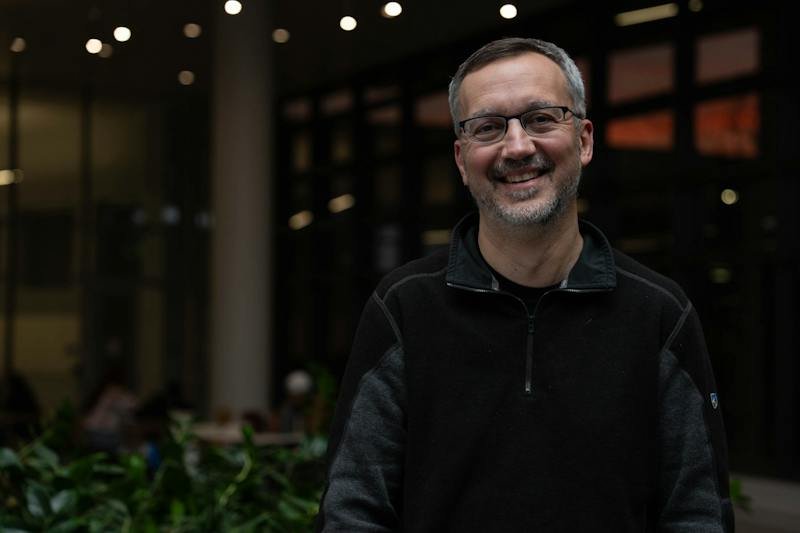
Remzi Arpaci-Dusseau, the dean of the College of Computing & Artificial Intelligence wants to help decide how
Remzi Arpaci-Dusseau, founding dean of the College of Computing and <a re a person in the technology sphere, like, you tend to imagine the positives because you don't want to be working on something that's bad,” Arpaci-Dusseau said.
Now, Arpaci-Dusseau said he sees the same shift occurring with AI. As the founding Dean of the College of Computing and Artificial Intelligence at the University of Wisconsin-Madison, Arpaci-Dusseau said he is not trying to repeat the web’s mistake of hoping things will turn out positively by chance.
“We have to work to make sure that the technology lands in society in a way that’s good for society,” Arpaci-Dusseau said.
Arpaci-Dusseau earned his bachelor’s in computer science from the University of Michigan in 1993, and later returned for his doctorate in 1999. He has taught at UW-Madison since 2000, and served as department chair of computer sciences from 2019 to 2023. In 2023, Arpaci-Dusseau went on sabbatical, intending to return to research and teaching.
He said he spent his sabbatical tapping into UW-Madison’s deep alum base. Everyone he talked to not only said AI would change Silicon Valley, but that the change would happen very quickly. Arpaci-Dusseau decided the university needed to be prepared.
“I just thought I was going to go back fully to research and teaching, but that ChatGPT moment was kind of ringing in my ears,” Arpaci-Dusseau said.
Arpaci-Dusseau said he spent two years working to create the College of Computing and Artificial Intelligence, but never expected to be the one to lead it.
“I feel like university structures should be a mirror of societal structures,” Arpaci-Dusseau said. “So, if we have some huge industry going on in the world that’s driving so much of how we think about the world and where the future is going, for good or bad, like, shouldn’t we have structures in the university that mirror that and help maybe shape that?”
Arpaci-Dusseau said students will begin to shape the future of AI, in roles such as AI consultants. He sees opportunities for AI to empower students and employees in their current roles rather than replacing them.
Last summer, Arpaci-Dusseau placed undergraduate students in local companies with small IT departments. Two juniors, Slava Ludenko and Siddharth Singh, spent the summer at Packer Fasteners, a Green Bay company with roughly 220 employees, Ludenko said in an email to the Cardinal. The CEO of Titletown gave them a project to complete over the course of a summer; Singh and Ludenko completed it in a weekend.
Enjoy what you’re reading? Get content from The Daily Cardinal delivered to your inbox
“That’s just kind of the world of systems building right now,” Arpaci-Dusseau said. “You can just build so much stuff so quickly in a way that’s hard for people to really deeply understand. Even people who are the most seasoned I know cannot estimate how long projects will take because they just can happen so much faster than they used to.”
From there, Arpaci-Dusseau said the students trained sales and finance employees how to use AI agents to build their own tools, like dashboards. By the end of the project, 40 to 50 of the company’s employees were using the new tools every day
“It [AI] takes people in their roles and makes them able to do more,” Arpaci-Dusseau said.
AI has completely changed how people program, and therefore university curricula must become AI-resilient, according to Arpaci-Dusseau. Assessments in the computer science department are moving in person to ensure that all work is done by students, which is a university-wide challenge, he said.
However, he said it is important to let students gain experience with AI, as these tools are increasingly integrated into companies and the workforce.
The College of Computing and Artificial Intelligence is developing its own degree, according to Arpaci-Dusseau. Each department within the college unanimously approved the degree, but it must pass the university for approval and then the board of regents.
According to Arpaci-Dusseau, if approved, the degree would have an ethics requirement and a societal impact of technology requirement.
“They [the requirements] open your eyes to the maturation we’re hoping for in our students, not just to be interested in the technology, but to also be helping shape how it lands in the world,” Arpaci-Dusseau said.
Arpaci-Dusseau says that it would be naive of <a s role is to act as a “counterbalance” to industry.
The university raised $250 million in private donations for the construction of Morgridge Hall, and another $100 million to launch the College of Computing and Artificial Intelligence, Arpaci-Dusseau said. Arpaci-Dusseau works with industry regularly, but those relationships can never come with strings attached, he said.
“In the end, we’re scientists, and so science is the pursuit of truth,” Arpaci-Dusseau said. “If we can’t be seeking the truth here, however idealistic that sounds, like where in the world can we be doing it?”
Leading the first new college at UW-Madison since 1983, Arpaci-Dusseau no longer has time to teach and has less time for research. He said he misses building rapport with students and will find a way to return to the classroom in the future.
He still makes time to lead a PhD research lab, which he co-leads with his wife, Andrea Arpaci-Dusseau. The lab has graduated 37 Ph.D. students studying computer systems and why coding agents make mistakes and how to minimize them, Arpaci-Dusseau said.
“I think it’s important to stay connected to the research and how the field is advancing because otherwise I don’t know what’s going on either,” Arpaci-Dusseau said.
Arpaci-Dusseau said he himself is integrating AI into his everyday workflows. By his estimation, he has written more <a s happening in the world. Like, why aren't they doing something?” Arpaci-Dusseau said. “And the reason we would say that is to remind ourselves like sometimes it has to be you.”
Support your local paper
Donate Today
The Daily Cardinal has been covering the University and Madison community since 1892. Please consider giving today.
After blue wave washes over the Capitol, what can Wisconsin Democrats bring afloat?
Iconic UW bars have to face a harsh reality: a generation that doesn’t drink