ByAnthony Di Pizio–Nov 23, 2026 at 4:12AM EST
Key Points
- businesses of all sizes.
- Palo Alto Networks has an expanding portfolio of cybersecurity products designed to protect enterprises in the AI era.
- Palo Alto stock continues to soar, even in the face of a <a s largest pure-play cybersecurity company. Its stock has exploded higher by 97% so far in 2026 (as of the market close on Nov. 19), and it has continued to trade in the green over the past month despite a sharp decline in the S&P 500(^GSPC-3.70%) and Nasdaq-100 indexes.
The company is experiencing a surge in demand for its portfolio of cybersecurity products, as enterprises try to protect their digital assets from a series of new threats posed by <a s what I think.
AI is transforming the threat landscape
The traditional approach to cybersecurity is no longer sufficient. Enterprises can’t piece together products from different vendors and hope to achieve adequate protection anymore, because they rarely work well together and can’t stop modern threats in real time. That’s why Palo Alto is focused on “platformization,” which involves encouraging its customers to ditch other vendors and consolidate their cybersecurity spending into its product ecosystem alone.
With this strategy, enterprises will have a unified set of tools to identify their weak points, uncover threats in real time, protect their data when deploying AI internally, and stop cyberattacks in their tracks.
Cortex XSIAM is one of Palo Alto’s most successful products for the AI era so far. It’s an AI-powered security operations platform that automates threat detection and incident remediation processes, reducing the workload on human managers who are struggling to keep up with the sheer volume of incoming attacks. XSIAM reduces the average customer’s incident response time to just 10 minutes, from days previously.
Then there is Palo Alto’s Prisma AIRS platform, which keeps track of internal AI chatbots and agents, and continuously scans third-party AI models for vulnerabilities. It’s effectively a gateway for all AI-related traffic, guarding the enterprise against malicious applications. Idira is an identity tool embedded directly into Prisma AIRS, and it manages permissions to ensure AI agents only have access to sensitive data when it is absolutely necessary.
PANWPalo Alto Networks
NASDAQ · As of 4:00 PM ET 11/20/26
Premium FeatureMoneyball Superscore88/100
Key data points
Market capMarket cap calculated using publicly traded shares outstanding only. Does not include unlisted, private, or dual-class non-traded shares. Implied market cap may vary.$281.10B
Day’s range$341.50 – $366.79
52wk range$139.57 – $432.33
Volume108.4K
Avg volume6.6M
Gross margin63.65%Palo Alto’s revenue growth is accelerating
Palo Alto generated $3.4 billion in total revenue during its fiscal 2027 first quarter (ended Oct. 31), a 39% increase from the year-ago period. That growth rate accelerated from 34% in the previous quarter three months earlier, so the company is carrying significant momentum right now.
Palo Alto had 2,670 platformed customers at the end of the quarter, representing an eye-popping 84% increase. Those customers had a net revenue retention rate of over 120%, meaning they increased their spending by at least 20% (on average) compared to the same time last year.
Platformized customers are the biggest buyers of Palo Alto’s next-<a s where Palo Alto stock could go from here
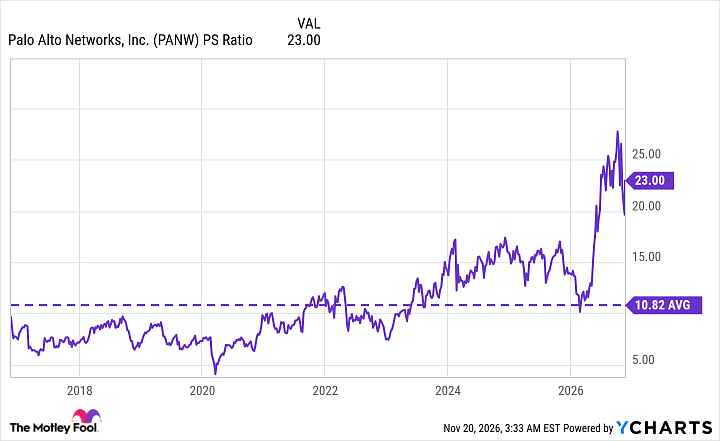
Following its incredible gain in 2026, Palo Alto stock is now trading at a price-to-sales (P/S) ratio of 23, which is more than twice its 10-year average of 10.8.