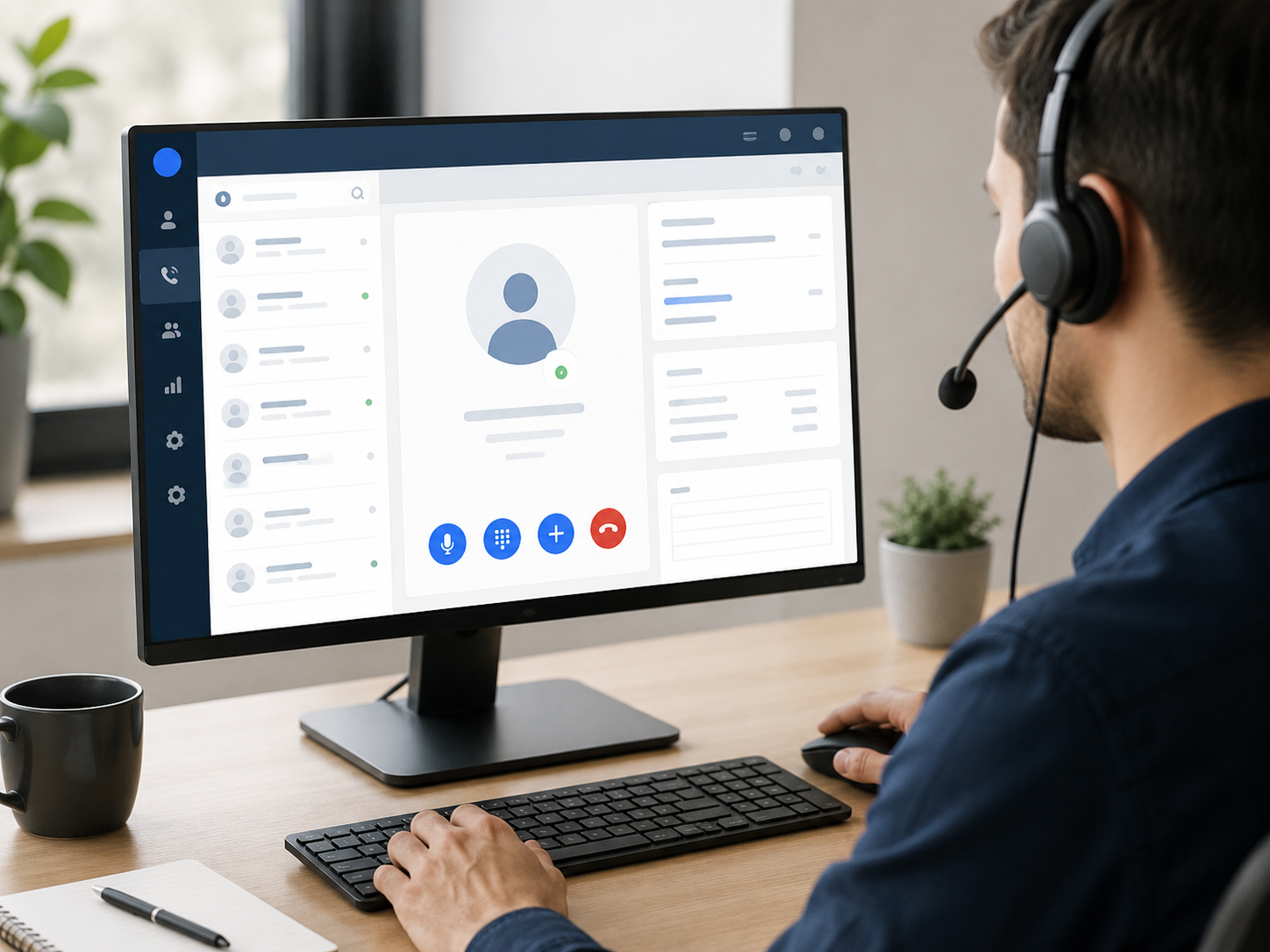
Business, sales, product management – illustrative photo. Image credit: LinkedIn Sales Solutions
If your sales reps are dialing numbers by hand, you’re losing revenue to competitors who automate. Manual dialing, listening to ringtones, and navigating voicemails drain hours from your team’s day.
Outbound dialer software solves this by automatically queueing and dialing contacts, dropping pre-recorded voicemails, and logging call outcomes directly into your CRM. The result? Your reps spend less time clicking and more time having meaningful conversations.
We’ve reviewed and tested 30+ top outbound dialers to help you accelerate your sales outreach and close more deals in 2026.
Here is a quick overview of the 11 best outbound dialer software platforms:
- CloudTalk — best overall for high-velocity sales teams needing parallel dialing and seamless CRM sync.
- Aircall — best for teams heavily focused on basic CRM-driven workflows.
- Dialpad — best for teams wanting built-in AI transcriptions and coaching.
- RingCentral — best for distributed teams needing an all-in-one communications suite.
- Nextiva — best for organizations prioritizing maximum uptime and reliability.
- Talkdesk — best for large enterprise contact centers with complex needs.
- 8×8 — best for global enterprises requiring unified voice and video.
- Vonage — best for businesses that want a highly customizable, modular setup.
- Five9 — best for compliance-heavy, high-volume enterprise campaigns.
- JustCall — best for small teams looking for a simple, budget-friendly dialer.
- Convoso— best for mid-sized sales teams that rely on high-volume outbound calling.
What is an Outbound Dialer?
At its core, an outbound dialer is a software application that automatically dials phone numbers from a contact list or CRM.
Instead of a sales rep manually typing out a 10-digit number, listening to the phone ring, and waiting to see if someone picks up, the software handles all that busywork automatically.
When a prospect actually answers the phone, the dialer instantly connects that live call to your agent. Think of it as a digital assistant that removes the repetitive, manual parts of cold calling or customer outreach.
Why Do High-Performing Teams Use Them?
When you eliminate manual dialing, your reps can spend their time doing what they actually do best: having meaningful conversations.
Here is why businesses make the switch to automated dialers:
- Double the Call Volume: Reps can easily make 2x or 3x more calls per day because there is zero idle time between dials.
- Smarter Workflows: Advanced dialers automatically filter out busy signals, disconnected numbers, and voicemails.
- Seamless CRM Sync: Calls, notes, and outcomes are instantly logged into tools like Salesforce, HubSpot, or Pipedrive—no manual data entry required.
- Better Contact Rates: Managing caller ID reputation, monitoring number health and using the right numbers to reach prospects can help businesses improve contact rates, reduce wasted calls and keep sales agents productive.
The 3 Main Types of Outbound Dialers
Not all dialers work the same way. As a consultant, I always tell teams to match their dialer type to their specific sales motion. You’ll typically choose from one of these three modes:
Power Dialer (Sequential): Dials one number at a time automatically. This is perfect for B2B sales where reps need a few seconds to review CRM notes before the call connects.
Parallel Dialer: Dials multiple numbers (e.g., up to 5) at the exact same time. The rep is connected to whoever answers first. This is ideal for high-volume outreach where pickup rates are typically low.
Predictive Dialer:Uses algorithms to dial ahead of agent availability. While predictive dialing can increase calling efficiency for high-volume campaigns, businesses need to manage dialing rates, agent availability and compliance to minimise abandoned calls and awkward pauses when prospects answer.
The Takeaway
If your team is still dialing by hand, you are leaving revenue on the table and burning your agents out on administrative tasks.
Upgrading to a modern, AI-powered system ensures your team connects with more leads in less time, while automatically handling all the post-call data entry.
The 10 Best Outbound Dialer Software Solutions for 2026
1. CloudTalk
CloudTalk is an AI-powered, cloud-based VoIP solution designed specifically to help SMB sales teams work smarter and scale quickly. It is our top pick for outbound dialer software because it balances high-velocity dialing features with deep CRM integrations and real-time analytics.
With CloudTalk’s AI Sales Dialer, your reps can use Sequential Dialing to preview contact details before calling, or Parallel Dialing to call up to 5 contacts simultaneously. The system automatically detects voicemails, drops a pre-recorded message, and moves to the next lead, ensuring your reps only spend time talking to live prospects.
Best for: Growing sales teams that want to double their conversation rates using smart automation, voicemail detection, and native CRM integrations.
Key Features:
- Parallel & Sequential Dialers: Automate your outreach and eliminate manual dialing.
- Voicemail Detection & Drop: Automatically detect answering machines and leave a pre-recorded message with one click.
- Automatic Outbound Caller ID: Automatically select a local number matching the prospect’s country or US area code to increase pickup rates.
- Native CRM Integrations: Seamlessly syncs calls, notes, tags, and outcomes to HubSpot, Salesforce, Pipedrive, and Zoho.
- Conversation intelligence to assist reps during outbound calls.
For outbound teams, Dialpad offers real-time transcriptions and AI-assisted coaching pop-ups. If a prospect mentions a competitor, Dialpad can surface a battle card on the rep’s screen instantly.
Best for: Agile sales teams that want real-time AI coaching and transcription built into their dialing workflow.
Key Features:
- Real-time AI call transcriptions and summaries.
- Live agent coaching and sentiment analysis.
- Built-in video conferencing.
Pros:
- Affordable starting price.
- Highly modern, sleek user interface.
- Excellent AI features included out-of-the-box.
Cons:
- Lacks advanced automated dialer modes (Smart/Parallel dialers).
- Limited international SMS capabilities compared to competitors.
Pricing: Starts at $15/user/month.
4. RingCentral
RingCentral is a heavyweight in the UCaaS (Unified Communications as a Service) space. It provides a robust, enterprise-grade platform that includes outbound dialing, video meetings, team chat, and faxing.
If you have a large, distributed workforce that needs a single app for all internal and external communication, RingCentral is a safe bet. However, for pure high-velocity outbound sales, its interface can feel a bit bulky.
Best for: Mid-market to enterprise businesses that need an all-in-one communication suite.
Key Features:
- Advanced call routing and analytics.
- Comprehensive team messaging and video conferencing.
- Massive app integration ecosystem.
Pros:
- Highly reliable with global coverage.
- Replaces multiple tools (Zoom, Slack, desk phones) with one app.
Cons:
- Features can be overwhelming for teams that just want a simple dialer.
- Strict, inflexible contract policies.
- Support response times can be slow.
Pricing: Starts at $20/user/month.
5. Nextiva
Nextiva blends VoIP communication with customer engagement tools. They are renowned for their 99.999% uptime and reliable infrastructure, making them a favorite for industries that cannot afford dropped calls.
Their outbound dialing features are solid, though they focus more on unified communication and internal collaboration than high-speed sales automation.
Best for: Organizations like healthcare or legal firms where call reliability and uptime are the highest priorities.
Key Features:
- Unlimited domestic calling.
- Built-in CRM and collaboration features.
- Virtual faxing and SMS support.
Pros:
- Industry-leading voice quality and uptime.
- Responsive, U.S.-based customer support.
Cons:
- Integrations are limited compared to CloudTalk or Aircall.
- Higher pricing tiers are required to unlock advanced features.
6. Talkdesk
Talkdesk is an enterprise-grade cloud contact center designed for large-scale sales and support operations. It offers deep AI-driven analytics, advanced routing, and powerful dialers meant to handle massive call volumes.
Because it is built for the enterprise, it requires a significant investment in both time and money to implement properly.
Best for: Large enterprises and dedicated contact centers that need highly customizable, complex call workflows.
Key Features:
- Advanced conversational AI and virtual agents.
- Deep, customizable reporting and analytics.
- Enterprise-ready compliance and security.
Pros:
- Highly scalable for massive global teams.
- Exceptional integration depth with enterprise CRMs like Salesforce.
Cons:
- Very expensive for small or mid-sized teams.
- Complex setup requires dedicated IT resources.
Pricing: Starts at $85/user/month.
7. 8×8
8×8 offers a single platform for voice, video, chat, and contact center capabilities. It is particularly well-known for its impressive global reach, offering unlimited calling zones that span dozens of countries.
Their outbound dialer features include predictive and progressive dialing, making it a strong contender for international telemarketing teams.
Best for: Global sales teams that make high volumes of international calls and need predictable billing.
Key Features:
- Unlimited calling across up to 48 countries (on higher tiers).
- Omnichannel routing and analytics.
- Native Microsoft Teams integration.
Pros:
- Excellent global coverage and cost predictability.
- Unified app experience across mobile and desktop.
Cons:
- The user interface feels dated compared to newer platforms.
- Advanced contact center features are locked behind expensive tiers.
Pricing: Quote-based.
8. Vonage
Vonage is a highly flexible, modular cloud communications platform. With a strong focus on APIs, it allows businesses to build highly customized dialing workflows and integrate voice directly into their own proprietary apps.
For teams that don’t want to build from scratch, they also offer a standard unified communications app with basic power dialing features.
Best for: Development-heavy teams that want to use APIs to build customized outbound calling experiences.
Key Features:
- Highly customizable communication APIs.
- Smart call routing and advanced queues.
- Desktop and mobile apps for out-of-the-box use.
Pros:
- Ultimate flexibility for custom integrations.
- Reliable global call quality.
Cons:
- Modular pricing means add-ons can quickly inflate your monthly bill.
- Out-of-the-box dialer lacks the AI automation of specialized sales tools.
Pricing: Starts at $17.99/user/month.
9. Five9
Five9 is a legacy giant in the cloud contact center space. It is built specifically to handle high-volume inbound and outbound campaigns. Their outbound dialer suite includes predictive, progressive, and power dialing modes.
Five9 places a heavy emphasis on TCPA compliance, making it a safe choice for massive telemarketing operations in highly regulated industries.
Best for: Enterprise telemarketing teams that prioritize compliance and predictive dialing at scale.
Key Features:
- Predictive and progressive dialers.
- Advanced TCPA compliance tools.
- Omnichannel support (voice, email, chat, social).
Pros:
- Extremely powerful for massive call volumes.
- Deep, granular reporting capabilities.
Cons:
- Overkill and far too expensive for SMBs.
- Outdated user interface requires a steep learning curve.
Pricing: Starts at $119/user/month.
10. JustCall
JustCall is a straightforward, budget-friendly cloud phone system that integrates easily with popular CRMs. It offers a native Auto Dialer and Predictive Dialer designed to help small teams increase their daily call volume.
While it lacks the advanced AI insights and enterprise-grade reliability of larger platforms, it gets the job done for startups running lean operations.
Best for: Startups and very small teams looking for a simple, budget-friendly outbound dialer.
Key Features:
- Auto dialer and predictive dialer.
- SMS automation and bulk texting.
- Basic CRM integrations.
Pros:
- Very affordable starting price.
- Fast, simple setup.
Cons:
- Lacks advanced AI and conversation intelligence features.
- Call quality and support response times can be inconsistent.
Pricing: Starts at $29/user/month.
11. Convoso
Convoso is an AI-powered outbound sales platform built for mid-sized businesses and contact centers that rely on high-volume calling to acquire new customers. It brings together high-performance dialing, campaign management and intelligent number management to help sales teams connect with more prospects, improve contact rates and reduce customer acquisition costs.
Unlike basic outbound calling solutions, Convoso combines multiple dialing modes with automated campaign workflows and real-time number health and reputation monitoring. Businesses can use predictive, power and preview dialing to support different sales strategies, while AI-powered dialing optimization dynamically adjusts call pacing based on connect rates and agent availability.
Best for: Mid-sized outbound sales teams and contact centers with 20–500 agents that need advanced dialing capabilities, campaign automation and intelligent number management.
Key Features:
- Multiple Dialing Modes: Supports preview, power, predictive and clicker agent functionality to accommodate different outbound sales strategies.
- AI-Powered Dialing Optimization: Dynamically adjusts dialing rates based on connect rates and agent availability, helping reduce agent idle time and maintain <a https: alt="">
8 Best AI Virtual Receptionists for Small Businesses (2026)
10 Best VoIP Calling Solutions for Modern Business Teams in 2026

Best Cold Calling Software in 2026 (Tested & Compare)

The Best Parallel Dialer for SMBs in 2026 (10 Tools Compared)

What is the best AI voice agent for businesses in 2026?

7 Best AI Answering Services for 2025: Ranked and Reviewed
Top Property Management Software Development
How Cross-Border Mobile Top-Ups Keep Families Connected Worldwide

Best MCP Servers for Payroll and HR in 2026