



Artificial intelligence (AI) has been the dominant theme in global financial markets since late 2022, with equities in the infrastructure buildout. However, AI’s influence on markets extends beyond a narrow set of infrastructure providers and stretches further back in time. Many firms integrate AI into their businesses, either by developing AI-enhanced products or by adopting AI-enabled processes that improve productivity.[1] This box therefore introduces a new firm-level measure of AI exposure derived from AI-related discussions in earnings call transcripts. It uses this measure to examine how the AI exposure of European firms is reflected in their equity returns and corporate bond spreads.[2]Chart A
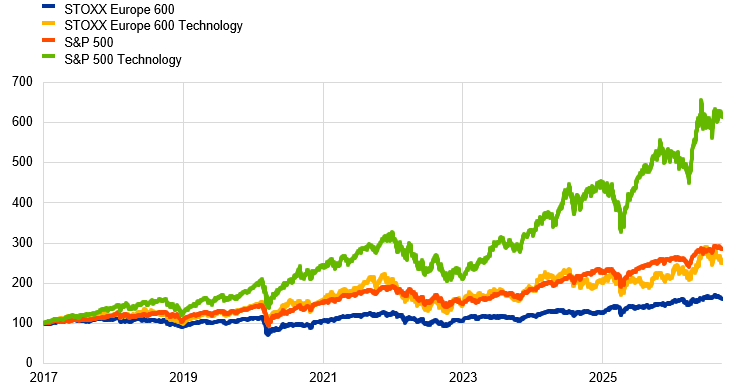
Performance of the STOXX Europe 600 and S&P 500 and their technology subsectors
Firms are classified as AI-exposed when their earnings calls link AI to infrastructure provision, product development, or improvements in business processes and productivity.[3] These criteria are applied across STOXX Europe 600 constituents, identifying not only firms that supply AI technology but also firms across all sectors that embed AI in their products and operations. The approach also captures the evolving nature of AI: as the technology matures and diffuses across sectors, firms’ disclosures shift accordingly, allowing a measure grounded in contemporaneous statements to track this evolution. This is valuable given the reliance of analysis on timely identification of AI-related news. Accordingly, AI exposure is measured quarterly from 2017 onwards and treated as time-varying, allowing the analysis to control for firm heterogeneity and sector-specific time variation.[4]
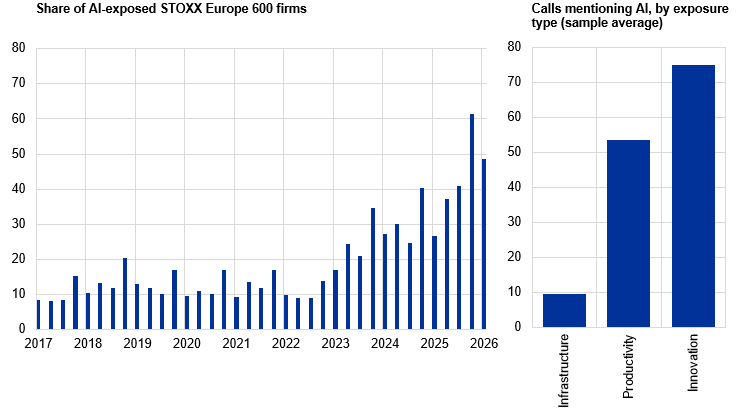
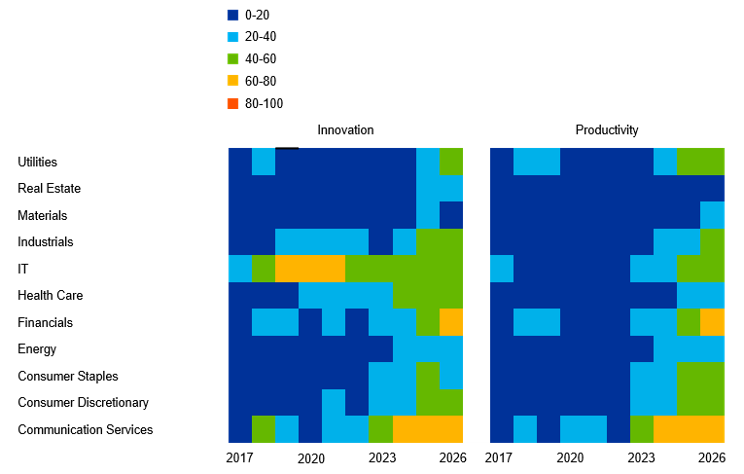
The share of AI-exposed firms has risen markedly since 2022, with AI predominantly mentioned in earnings calls as a source of product innovation and growth (Chart B). 75% of earnings calls mentioning AI refer to product innovation or growth opportunities from an AI-enhanced product offering, while 50% discuss AI-related productivity gains, with some mentioning both. There is clear heterogeneity across sectors and over time: IT firms mentioned AI-related product innovation as far back as 2017, whereas firms in other sectors mainly started to refer to productivity improvements resulting from AI after the launch of ChatGPT in late 2022. This is consistent with the findings of the ECB’s Survey on the Access to Finance of Enterprises in the euro area in June and December 2025, which show more innovation-oriented cases of AI use in the IT sector and greater emphasis on cost reduction in manufacturing, construction, trade and other services.[5]
Chart B
Share of AI-exposed STOXX Europe 600 firms and breakdown by AI exposure type
b) Share by innovation and productivity exposure
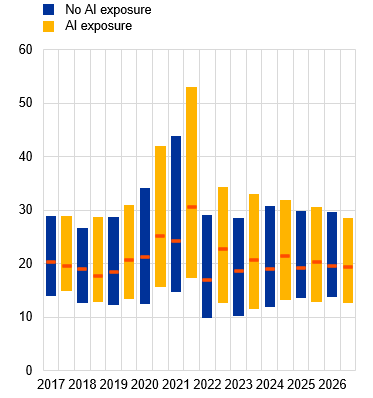
b) Maturity structure of new bond issuances
(left-hand scale: percentages, right-hand scale: percentages per annum)
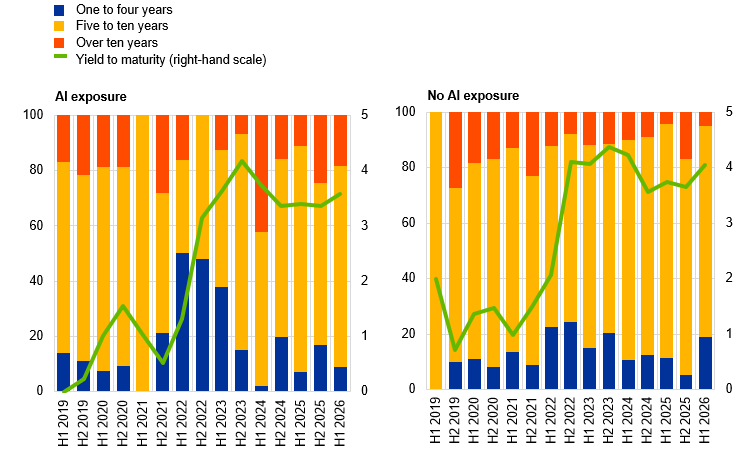
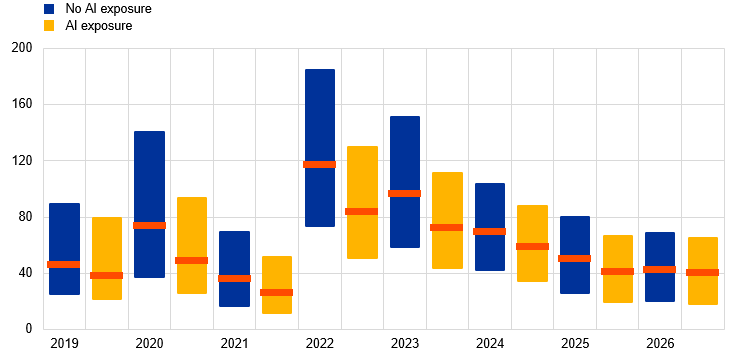
The findings in this box suggest that AI exposure is positively reflected in equity and corporate bond pricing across the wider economy in Europe. AI’s association with lower market-based financing costs is more widely distributed than the concentrated equity rally in the IT sector suggests. However, this relationship rests on expectations about the technology’s returns. Should those expectations disappoint, valuations and spreads could reprice abruptly and broadly, extending well beyond the firms driving the AI investment cycle. Further analysis is warranted to establish the potential scale of this repricing and its effect on aggregate financing conditions in the euro area.[10]
References
Andersson, M., Breckenfelder, J., Corradin, S., Nikolov, K. and Viola, M.A. (2026), “The AI boom: rational enthusiasm or the next dot-com bubble?”, TheECB Blog, ECB, 17 August.
Acemoglu, D. and Restrepo, P. (2020), “
<p>Babina, T., Fedyk, A., He, A. and Hodson, J. (2024), “
